


Validation and autochecks
Validation turns a prepared source into a list of findings and remaining decisions. Choose the page or selected-section scope first; then fix findings, rerun the check, and review what the tool did not cover. This page explains that boundary and the broader validation model—it is not a claim that the plugin runs every rule below.
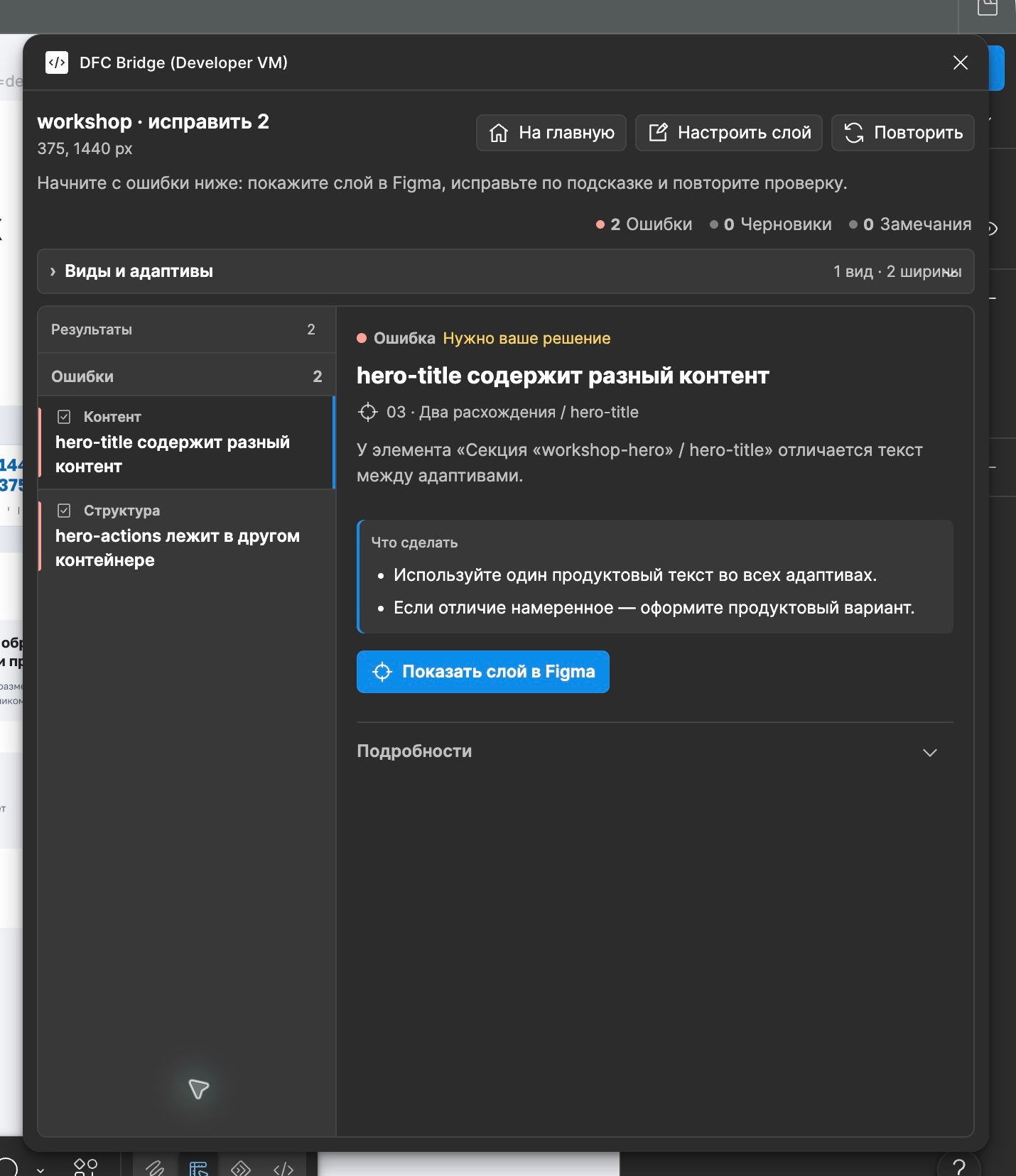
The visual introduction shows why these decisions matter to the team.
Validation layers
Section titled “Validation layers”These layers organize the methodology’s rules. The current coverage distinguishes implemented source checks from checks that need structured data, an implementation, or human judgment.
- Syntax validation — tags, boolean visual-intent/draft flags, optional tag values, keys, href/action syntax, breakpoint tags.
- Identity validation — identity uniqueness, identity stability, breakpoint-neutral identity values, type stability, and correct exclusion of
[decor]/[asset]flags from identity-tag counting. - Responsive validation — identity coverage, tree topology/cardinality, parent-child stability, visibility changes, visual-intent drift, content drift, order changes, breakpoint completeness.
- Structure validation — page/section/content-container Auto Layout, forbidden non-asset GROUP nodes, wrappers, clipping, positioning intent, fixed heights, overlaps.
- Interaction graph validation — href links, draft link/control markers, actions, targets, modals, states, forms.
- Content validation — text equality, strict legal/price content, rich text, localization risk; skip product-content drift checks for text inside decorative/root asset visuals.
- Asset validation — asset policy, native text misuse, export settings, focal points.
- Accessibility validation — contrast risk, touch targets, labels, focusable states, decorative layers hidden from the accessibility tree.
- Adapter capability validation — target-specific unsupported features.
Automation levels
Section titled “Automation levels”- Automatic — can be checked deterministically from extracted design data.
- Heuristic — can be detected with confidence, but may need designer confirmation.
- Manual — must be checked by a human, but the checklist should make it explicit.
Report severity
Section titled “Report severity”- error — blocks readiness in the checked scope.
- warning — requires explanation or fix before serious transfer.
- info — useful context for implementers and adapters.
Minimum validator pipeline
Section titled “Minimum validator pipeline”extract design tree -> normalize names, boolean visual-intent tags, optional tag values, keys, and Figma metadata -> discover page roots among direct Figma-page children and through native Figma SECTION organizers only -> group roots by page, then by view, then by breakpoint -> build identity map and type map -> check optional identity-bearing values against current breakpoint names/widths -> compare responsive tree cardinality and parent identities only inside one page/view group -> compare visibility, sibling order, and visual-intent flags inside each parent -> compare product content across breakpoints, excluding decorative/root asset visuals -> classify page, section, generic content-container, primitive/leaf, component-instance, and opaque asset boundaries -> inspect native node type and layout mode; require Auto Layout and reject non-asset GROUP nodes -> validate exact-node absolute decor/overlay intent without treating [decor] as a structural exemption -> classify remaining wrappers and positioning intent -> build href/action-target graph -> inspect geometry, overflow, and fixed heights -> check assets and component states -> emit report with rule IDs, severity, location, and fix hintsNative Figma Sections are transparent only during page-root discovery. The validator does not inherit their names/tags, serialize them into the DFC Bridge page tree, or use them to suppress layout rules. It stops root discovery at ordinary FRAME/GROUP wrappers, then validates only the discovered tagged roots and their own subtrees.
Check selected section
Section titled “Check selected section”Check selected section is a separate audit mode for a new DFC Bridge section inside a legacy/non-DFC Bridge host. It must not run the page pipeline with fabricated metadata.
read explicit selection -> resolve each selected node to its nearest own/ancestor [section=<stable-id>] boundary -> reject empty/untagged selection, a page root, mixed section ids, or a section below an inherited [asset] as Blocked scope -> deduplicate normalized roots; traverse only those roots and descendants -> treat [asset] as opaque, descendant INSTANCE as a trusted atomic boundary, and [decor] as traversed intent -> run local identity, syntax, structure, content, and internal-target checks -> compare only explicitly selected variants of one section when 2+ usable roots exist -> defer only references that require lookup outside selected roots plus file/page/integration concerns -> emit scope-qualified Ready, Partial, or Blocked plus a persistent coverage matrixAn editable FRAME or COMPONENT root receives full subtree inspection. A selected GROUP may be normalized so the report can emit the existing blocking layout.group-outside-asset finding; it cannot become Ready outside an opaque asset. If the normalized selected section root itself is an INSTANCE, it exposes only boundary evidence and the result is Partial. Ordinary descendant instances are trusted atomic boundaries: their internals are not applicable to this traversal and do not lower Ready. An exact [section=id] [asset] root is valid and opaque, so internal layout coverage is N/A. A section below a different asset ancestor is Blocked before traversal; inherited opacity is not an exemption. [decor] alone never stops traversal.
One normalized root declares one requested context and can be Ready when that declared context is clean. Absence of variants the user did not request is not requested, not Partial or a missing-breakpoint error. Two or more explicitly selected roots must share one section id; they become declared selected variants. A context label inferred from root/container width is marked inferred, and the validator never discovers neighboring legacy frames to manufacture coverage.
| Coverage class | Selected-section meaning |
|---|---|
| Local | The selected subtree can prove intrinsic tag/identity and action/href syntax, source structure, content evidence, targets inside the roots, and complete valid http:, https:, mailto:, or tel: href values. Incomplete/malformed external values are blocking, not Deferred. |
| Selected variants | Identity/type, logical tree/cardinality, parents, product text, and visual intent are compared only across explicitly selected usable variants. |
| Deferred | Internal routes/anchors and action/component/data targets requiring lookup outside selected roots, plus page root, page/view/route completeness, required page breakpoints, global uniqueness, host placement, page semantics, runtime, production accessibility, and WCAG conformance require separate evidence. |
Exact implemented rule IDs and applicability live in the selected-section coverage manifest. Its exact union is tracked independently from Page Check and the two counts must not be added.
Rule catalog overview
Section titled “Rule catalog overview”The machine-readable seed lives in ../validator/rules.json.
| Group | Example rule | Severity | Automation |
|---|---|---|---|
| Identity | identity.missing-stable-identity |
error | automatic |
| Identity | identity.same-identity-different-type |
error | automatic |
| Identity | identity.breakpoint-specific-id |
error | automatic |
| Identity | identity.decor-asset-flags-not-identities |
error | automatic |
| Identity | identity.multiple-identity-tags |
warning | automatic |
| Syntax | syntax.decor-asset-value-not-kebab-case |
error | automatic |
| Syntax | syntax.identity-value-not-kebab-case |
warning | automatic |
| Syntax | syntax.duplicate-tag |
error | automatic |
| Syntax | syntax.figma-metadata-tag-invalid |
error | automatic |
| Structure | layout.page-root-missing-auto-layout |
error | automatic |
| Structure | layout.page-root-cannot-be-asset |
error | automatic |
| Structure | layout.section-missing-auto-layout |
error | automatic |
| Structure | layout.container-missing-auto-layout |
error | automatic |
| Structure | layout.group-outside-asset |
error | automatic |
| Structure | layout.positioned-without-intent |
warning | automatic |
| Section | section.component-source-unclassified |
warning | heuristic |
| Section | section.redundant-instance-section-tag |
warning | heuristic |
| Component | component.ui-kit-used-as-section |
warning | heuristic |
| Responsive | responsive.identity-missing-in-required-breakpoint |
error | automatic |
| Responsive | responsive.view-missing-required-breakpoint |
error | automatic |
| Responsive | responsive.tree-cardinality-changed |
error | automatic |
| Responsive | responsive.parent-changed-across-breakpoints |
error | automatic |
| Responsive | responsive.visual-intent-drift |
error | automatic |
| Content | content.text-changed-between-breakpoints |
error | heuristic |
| Content | content.decorative-asset-text-excluded-from-product-drift |
info | automatic |
| Content | content.manual-line-break-in-dynamic-text |
error | heuristic |
| Structure | layout.one-child-wrapper-without-role |
warning | heuristic |
| Structure | layout.overlap-without-overlay-role |
warning | heuristic |
| Interaction | interaction.clickable-without-action |
warning | heuristic |
| Interaction | interaction.link-without-href |
info | automatic |
| Interaction | interaction.control-without-action |
info | automatic |
| Interaction | interaction.href-placeholder-invalid |
error | automatic |
| Interaction | interaction.href-invalid |
error | automatic |
| Interaction | interaction.optional-id-value-invalid |
error | automatic |
| Interaction | interaction.action-invalid |
error | automatic |
| Interaction | interaction.control-action-duplicate |
error | automatic |
| Interaction | interaction.modal-target-missing |
error | automatic |
| Interaction | interaction.form-target-missing |
error | automatic |
| Interaction | interaction.reset-target-missing |
warning | automatic |
| Routing | routing.page-route-missing |
info | automatic |
| Routing | routing.page-root-required |
error | automatic |
| Routing | routing.default-view-missing |
warning | automatic |
| Routing | routing.route-not-production-url |
error | automatic |
| Height | height.fixed-height-without-reason |
warning | automatic |
| Overflow | overflow.text-clipping-risk |
error | heuristic |
| Asset | asset.raster-text-without-reason |
error | heuristic/manual |
| Accessibility | accessibility.decorative-layer-exposed |
warning | automatic |
| Interaction | interaction.form-field-missing-label |
warning | automatic |
For layout.section-missing-auto-layout, automatic means a non-page FRAME or COMPONENT carrying [section] is present in the audited tree. A placed INSTANCE is atomic: Page Check neither resolves its source component nor emits a section-layout finding for the instance. Select and audit the editable source tree separately.
Suggested report format
Section titled “Suggested report format”{ "methodology": "DFC Bridge", "status": "not-ready", "summary": { "errors": 3, "warnings": 8, "info": 4 }, "issues": [ { "ruleId": "interaction.modal-target-missing", "severity": "error", "nodeId": "contact-cta", "breakpoint": 320, "message": "Button references modal `contact-modal`, but no modal target exists.", "fix": "Create `[modal=contact-modal]` or change the action." } ]}For a section-scoped report, include the boundary and unfinished evidence rather than reducing everything to issue counts:
{ "methodology": "DFC Bridge", "mode": "section", "status": "partial", "scope": { "kind": "section", "rootIdentity": "checkout-summary", "boundary": "selected-subtree", "readinessClaim": "section-source-only" }, "coverage": { "evaluated": ["local-structure", "local-syntax"], "notRequested": ["selected-variant-comparison"], "deferred": ["file-resolved-targets", "host-integration"] }, "issues": []}Ready requires no errors, warnings/TODOs, selected-root source gaps, or deferred checks in the declared selected scope; trusted descendant instances and unrequested variants do not lower it. Partial has no blocking local error but retains a selected-root INSTANCE, an indistinguishable selected context, or another warning/deferred gap. Blocked means a missing/invalid tagged boundary, nested/mixed section roots, or a blocking finding. These labels never imply page, implementation, product, or WCAG readiness.
Checklist modes
Section titled “Checklist modes”Designer quick check
Section titled “Designer quick check”Use before showing the file to engineering:
- missing identities;
- missing actions;
- obvious fixed-height text;
- missing modal/state targets;
- changed mobile copy.
Reviewer strict check
Section titled “Reviewer strict check”Use before approving a handoff. Review the applicable rules below using their declared automatic, heuristic, or manual method; this is not one “run all” plugin command:
- full rule catalog;
- edge-case checklist;
- state coverage;
- accessibility warnings;
- adapter capability notes.
Adapter certification check
Section titled “Adapter certification check”Use to prove that a target implementation path supports DFC Bridge:
- supported tags;
- supported actions;
- unsupported visual features;
- asset fallback behavior;
- responsive mapping rules.
What should block handoff immediately
Section titled “What should block handoff immediately”- Missing stable identity on important elements.
- Duplicate identities inside a breakpoint/view scope.
- Responsive trees compared across different
[view=...]values. Each view is a separate responsive contract and is compared only across its own breakpoints. - Breakpoint-specific optional identity value, for example
[control=button-reviews-box-375]inside a[bp=375]root. - Same identity used for different logical types.
- Page root has native Auto Layout disabled; zero/one child,
[asset],[decor], or exception metadata on the page root does not suppress the rule. - Page root carries
[asset]; this is a separate blocker, does not create an opaque boundary, and does not stop descendant validation. - Frame-built section has native Auto Layout disabled, unless that exact section is a legitimate opaque whole-visual
[asset]with no live content flow. - Generic Auto Layout-capable container has two or more visible meaningful direct flow children while Auto Layout is disabled.
- Figma
GROUPexists outside an opaque[asset]subtree. Manual-layout plus reason documents a proposed deviation but does not suppress the structural error. - Stable decorative/asset root identity missing on a required breakpoint.
- Responsive element tree cardinality or parent-child topology changes without a structural exception.
- Visual intent drift such as
sneg [decor] [asset]on desktop becoming plainsnegon mobile. - Final clickable element without known
[href=...]or[action=...]; draft[link]/[control]markers are TODOs, not syntax errors. - Invalid unknown href placeholder
[href=#]; use[link]instead. - Fake or placeholder
[route=...]value; omit route until the production URL is known. - Action target missing.
- Modal without close behavior.
- Text fixed height with no overflow policy.
- Dynamic text that relies on manual line breaks.
- Hidden keyed layers used as source of truth.
- Rasterized text without explicit reason.
A page root without a known route is a Draft TODO (routing.page-route-missing), not a blocker. Likewise, draft [link] and [control] are valid markers of unfinished decisions, not proof that the interaction is ready.
False positives are acceptable
Section titled “False positives are acceptable”A validator should prefer useful friction over silent failure. False positives are acceptable if the report explains how to mark an intentional exception:
[bridge-exception=overlay] [reason=decorative-layered-composition]The goal is not to forbid complex design. The goal is to make complexity explicit. Structural Auto Layout/GROUP errors remain reported even when [bridge-exception=manual-layout] [reason=...] is present; those tags provide evidence for a separate deviation-acceptance gate rather than a Page Check pass. [bridge-exception=overlay] [reason=...] may satisfy positioning intent for the exact absolute overlay node.