


DFC Bridge transfer contract
The DFC Bridge Contract records the decisions that names and Figma properties cannot fully explain: data, responsive transformations, interaction outcomes, and delivery evidence. It connects the source design to implementation and QA without depending on one target platform.
Use this reference when building an integration or preparing a structured handoff. If you are preparing your first design page, start with the designer quick start. Below, the envelope defines what travels together, identity mappings connect it to the design, and validation checks whether those connections hold. The structured envelope and JSON Schema may evolve before 1.0, so every exchange pins contractVersion, methodologyVersion, and rulesVersion.
Two complementary surfaces
Section titled “Two complementary surfaces”DFC Bridge deliberately avoids turning layer names into a database.
Short layer tags
Section titled “Short layer tags”A designer uses a small grammar for intent that must remain visible while browsing the design:
catalog [page=catalog] [route=/catalog] [bp=1200] [view=default] products [section=product-results] product-grid [collection=products] product-card-oak-chair [item=product] filter [action=state:filters-open]Tags locate pages, variants, sections, links/actions, targets, fields, collections, visual policy, overflow, and explicit exceptions. They do not carry a data schema, state graph, motion timeline, accessibility test plan, or delivery history.
Structured bridge metadata
Section titled “Structured bridge metadata”Rich intent lives in one namespaced object. It references the stable identities visible in the design and may be stored as Figma plugin data, a sidecar JSON file, or an adapter payload. It must travel with the handoff and be validated as a unit.
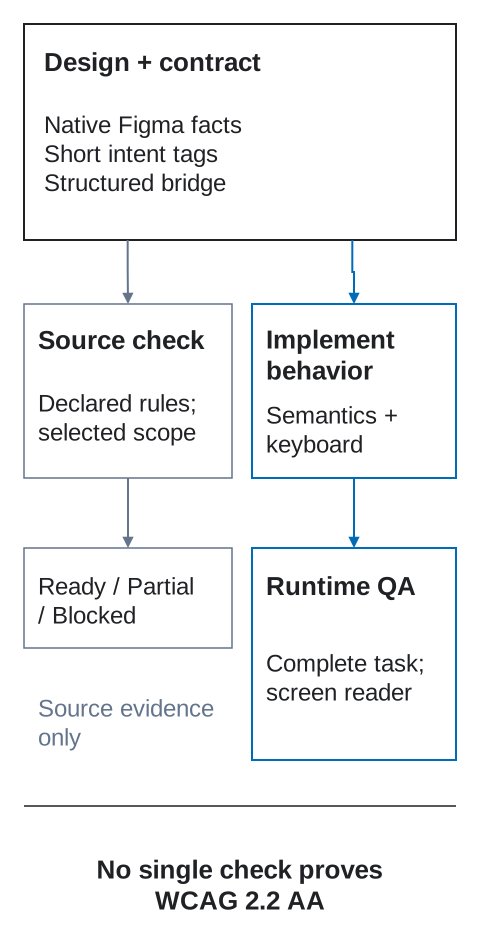
Figma/source metadata + short DFC Bridge anchors + structured bridge metadata ↓ one transferable contractDo not invent new flat tags when a structured field already exists.
Required envelope
Section titled “Required envelope”A complete payload has a bridge root. The core envelope includes:
| Field | Purpose |
|---|---|
contractVersion |
Version of the structured payload shape. |
methodologyVersion |
DFC Bridge release used to prepare the transfer. |
rulesVersion |
Rule catalog version used for validation. |
source |
Tool, file/page, immutable revision, and capture context. |
context |
Declared transfer scope, product/page context when applicable, included axes, and external dependencies. |
identity |
Mapping across role, template, design instance, runtime data, and target implementation. |
structure |
Logical trees in declared responsive/data contexts. Native Figma node type, layout mode, positioning, and asset boundaries remain source evidence validated alongside this tree. |
| Contract modules | data, responsive, interaction, motion, accessibility, capabilities, and lifecycle as applicable. |
openQuestions |
Known unknowns with owner, scope, blocking status, review point, and fallback. |
exceptions |
Intentional source/contract exceptions with impact and mitigation. |
An omitted module means “not applicable” only when the scope proves that it is not applicable. It must not mean “nobody checked.”
Identity is a mapping, not one overloaded id
Section titled “Identity is a mapping, not one overloaded id”A single name cannot safely represent every identity involved in transfer. DFC Bridge separates five dimensions:
| Dimension | Question | Example |
|---|---|---|
role |
What logical job does this element perform? | data item / product |
template |
Which reusable definition owns its shape and behavior? | product-card |
designInstance |
Which authored occurrence is this in the design and contexts? | product-card-oak-chair |
runtimeData |
Which record-key rule/fixture binds content at runtime? | collection products, key field sku |
target |
Which implementation entity realizes it? | web component ProductCard |
bridgeKey connects contract references; it does not collapse those dimensions. The value [item=product] is a repeatable role/type, not a unique design fixture or runtime record id. A positional name like product-card-3 may be a temporary design fixture identity, but it must never become the runtime record key. Sorting, filtering, pagination, live updates, and duplicate-looking records require a stable product key.
Interaction targets are different: a reaction refers to the bridgeKey of a modal, state, form, route, or element. The identity.elements[].target field maps an element to implementation code or another target platform.
Canonical illustrative payload
Section titled “Canonical illustrative payload”Read this example as a map of how modules fit together, not as a complete project to copy unchanged. It illustrates references whose full definitions are outside the excerpt. Real payloads include only applicable modules, keep the same namespaced shape, and resolve their references. For a complete executable fixture in the repository, use validator/examples/bridge-contract.valid.json.
{ "bridge": { "contractVersion": "0.2.0", "methodologyVersion": "0.11.7", "rulesVersion": "0.5.0", "source": { "tool": "figma", "fileKey": "example-file-key", "pageId": "12:4", "pageName": "Catalog", "versionId": "figma-version-2026-08-13T10:20Z", "capturedAt": "2026-08-13T10:25:00Z" }, "context": { "transferId": "catalog-default", "page": "catalog", "route": "/catalog", "view": "default", "axes": { "locale": "en-US", "theme": "light" }, "contextIds": ["catalog-1200", "catalog-360"] }, "identity": { "elements": [{ "bridgeKey": "product-card-oak-chair", "role": { "kind": "data-item", "semantics": "product" }, "template": { "templateKey": "product-card", "sourceComponentId": "55:8", "sourceComponentName": "UI Kit / Product Card" }, "designInstance": { "designInstanceKey": "product-card-oak-chair", "sourceNodes": [ { "contextId": "catalog-1200", "nodeId": "401:72", "layerPath": ["Catalog / 1200", "product-grid", "product-card-oak-chair"] }, { "contextId": "catalog-360", "nodeId": "509:21", "layerPath": ["Catalog / 360", "product-grid", "product-card-oak-chair"] } ] }, "runtimeData": { "collection": "products", "keyField": "sku", "fixtureKey": "oak-chair", "runtimeDataKey": "sku:CHAIR-OAK-01" }, "target": { "platform": "web", "kind": "component", "targetKey": "ProductCard", "locator": "src/catalog/ProductCard" } }] }, "structure": { "contexts": [ { "id": "catalog-1200", "rootIdentity": "catalog", "tree": { "product-results": ["product-grid", "filter-button"] } }, { "id": "catalog-360", "rootIdentity": "catalog", "tree": { "product-results": ["product-grid", "filter-button"] } } ] }, "data": { "displays": [{ "displayId": "product-grid", "purpose": "Browse products matching the active catalog query", "source": { "owner": "catalog-service", "dataset": "products", "refresh": "request" }, "dimensions": [{ "key": "sku", "type": "string" }], "measures": [{ "key": "price", "type": "decimal", "currency": "USD" }], "format": { "locale": "user", "currencyDisplay": "symbol" }, "states": ["loading", "empty", "error", "partial", "stale"] }] }, "responsive": { "defaultPolicy": "same-tree", "contexts": [ { "id": "catalog-1200", "driver": "viewport", "width": 1200 }, { "id": "catalog-360", "driver": "viewport", "width": 360 } ], "transformations": [{ "id": "comparison-table-to-disclosures", "fromContext": "comparison-wide", "toContext": "comparison-narrow", "when": { "driver": "container", "container": "comparison-panel", "condition": "max-width: 480px" }, "mappings": [{ "source": ["comparison-table"], "target": ["comparison-disclosures"], "semantics": "same-records-and-fields" }], "preserves": ["content", "actions", "field-relationships", "selection", "accessible-names"], "readingOrder": ["comparison-heading", "comparison-disclosures"], "focusOrder": ["comparison-disclosure-trigger:*"], "stateTransfer": "preserve-selection-and-open-record", "history": "no-new-entry" }] }, "interaction": { "stateMachines": [{ "id": "catalog-filter", "initial": "idle", "states": ["idle", "pending", "results", "empty", "failure"], "transitions": [{ "id": "apply-filter", "from": ["idle", "results", "empty", "failure"], "event": { "type": "submit", "source": "catalog-filter-form" }, "pending": { "to": "pending", "duplicateEvent": "replace-with-latest" }, "outcomes": { "success": { "to": "results", "focus": "results-heading", "announce": "Results updated" }, "empty": { "to": "empty", "focus": "results-heading" }, "failure": { "to": "failure", "focus": "filter-error", "retry": "preserve-values" } }, "history": "replace-query" }] }] }, "motion": { "sequences": [] }, "capabilities": { "profiles": [{ "id": "mobile-low-bandwidth", "target": { "platform": "web", "runtime": "browser" }, "essentialExperience": ["product-name-and-price", "filter-and-open-product"], "supports": ["responsive-images", "offline-cache"], "unsupported": [{ "capability": "scroll-timeline", "fallback": "static-scenes", "owner": "storefront" }], "assets": [{ "element": "product-image", "width": 960, "height": 960, "formats": ["avif", "webp", "jpeg"], "quality": "product-detail-visible", "artDirection": "square-crop-with-subject-safe-area", "loading": { "priority": "results-dependent", "poster": null, "strategy": "lazy-outside-first-window" } }], "data": { "expectedItems": 48, "maximumItems": 10000, "virtualizeAfter": 200, "strategy": "server-pagination" }, "conditions": ["low-bandwidth", "offline", "data-saver", "low-power"], "budgets": [{ "metric": "initial-results-payload", "limit": 250, "unit": "KiB", "owner": "storefront", "measureAt": "release-qa" }] }] }, "accessibility": { "profile": { "standard": "WCAG", "version": "2.2", "level": "AA" }, "elements": [{ "element": "product-grid", "name": "Catalog results", "readingOrder": ["results-heading", "active-filters", "product-grid", "pagination"], "testIds": ["catalog-results-keyboard", "catalog-results-reflow"] }] }, "lifecycle": { "transferId": "catalog-default", "contractRevision": "7", "sourceRevision": "figma-version-2026-08-13T10:20Z", "targetRevision": "build-1842", "status": "qa", "owners": { "design": "catalog-design", "contract": "design-systems", "implementation": "storefront", "qa": "quality" }, "requirements": ["REQ-CATALOG-017", "REQ-CATALOG-021"], "evidence": { "tests": ["catalog-grid-default", "catalog-grid-keyboard"] }, "deviations": [] }, "openQuestions": [{ "id": "OPEN-CATALOG-003", "scope": ["catalog", "offline"], "question": "May users open a product from stale cached results?", "owner": "catalog-product", "blocking": true, "due": "2026-08-18", "reviewAt": "contract-gate", "fallback": "Show cached results read-only and disable product navigation", "status": "open" }], "exceptions": [] }}The layer tags in the example remain the human-visible anchors; the payload adds relationships and decisions that cannot fit safely in names.
Same tree by default, transformation by declaration
Section titled “Same tree by default, transformation by declaration”responsive.defaultPolicy is same-tree. Geometry, Auto Layout direction, wrapping, order inside the same logical parent, and declared visibility may change without a structural mapping.
A topology or presentation change is valid only as a responsive.transformations[] record. It names source and result identities, the viewport/container condition, field/scene/action mapping, semantics preserved, reading and focus order, state transfer, and history behavior. If no transformation covers a difference, the difference is contract drift.
Native layout remains required source evidence
Section titled “Native layout remains required source evidence”The structured bridge.structure tree does not duplicate Figma’s native layoutMode, node type, or positioning fields. A source validator reads those fields directly and applies the rule catalog:
- page roots always use native Auto Layout and cannot be
[asset]; - frame-built section roots and
Page Sectionssource roots use Auto Layout unless the exact section is a legitimate opaque whole-visual asset; - generic Auto Layout-capable containers with at least two visible meaningful flow children use Auto Layout;
- GROUP nodes are valid only inside a genuine opaque
[asset]subtree; - primitive/leaf geometry and placed INSTANCE internals are not treated as content-flow containers;
[decor]identifies only the exact intended absolute visual node and never creates a structural exemption.
Page Check treats a placed INSTANCE as atomic and does not resolve its source component for the section-layout rule; audit the editable source root separately. An asset root still appears as one identity in the logical tree and one item in its parent’s Auto Layout. A manual-layout exception with a reason may accompany a reported structural deviation, but it does not change the source evidence or turn a failing Page Check into a pass.
Selected-section scope inside a legacy host
Section titled “Selected-section scope inside a legacy host”A team may apply DFC Bridge to one new section without migrating the surrounding product. The boundary is an explicitly selected source root carrying a stable section identity:
checkout-summary [section=checkout-summary]Do not turn the section into a fake page. [page], [bp], [view], and [route] remain page-root tags and must not be added merely to run validation. Check selected section traverses only the normalized selected root and its descendants. The result depends on what was selected:
- An editable
FRAMEorCOMPONENTreceives the full local source audit. AGROUPremains a blocking structural finding. - If the selected section root itself is an
INSTANCE, only boundary evidence is available and the result is Partial. - An ordinary descendant
INSTANCEis a trusted atomic boundary: its internals are not applicable to this traversal, so it does not lower Ready. - An exact
[section=id] [asset]root is a valid opaque whole-visual boundary. Internal layout is N/A. - A section below a different non-page-root
[asset]ancestor is an invalid Blocked scope: the check cannot pierce that inherited opaque boundary.
An illegal [asset] on a page root never creates opacity: Page Check reports that root separately and descendants remain inspectable. [decor] alone never stops traversal.
The structured scope records what was selected and what remains outside it. This is a non-standalone fragment; insert it into the required bridge envelope:
{ "context": { "project": "Legacy storefront section adoption", "scope": { "kind": "section", "rootIdentity": "checkout-summary", "boundary": "selected-subtree", "assetBoundary": "none", "hostCompliance": "legacy-out-of-scope", "selectionMode": "explicit-variants", "contextIds": ["summary-container-360", "summary-container-1200"], "readinessClaim": "section-source-only" }, "externalDependencies": [{ "id": "checkout-route-dependency", "kind": "route", "reference": "/checkout", "status": "deferred", "owner": "storefront-platform", "reviewAt": "host integration gate" }] }, "responsive": { "defaultPolicy": "same-tree", "contexts": [ { "id": "summary-container-360", "driver": "container", "width": 360, "label": "Container 360", "labelSource": "inferred-from-selected-root-width" }, { "id": "summary-container-1200", "driver": "container", "width": 1200, "label": "Container 1200", "labelSource": "inferred-from-selected-root-width" } ] }}Read the scope fields as follows:
assetBoundaryisnonefor an editable or atomic source root andselected-root-opaqueonly when that exact selected section root carries[asset]. An ancestor asset boundary cannot form a valid section-scope contract.single-rootdeclares one requested context and can be source-ready without inventing unrequested variants.explicit-variantsmeans that the user explicitly selected two or more roots with the same[section]identity for comparison. The validator must not discover legacy siblings and silently expand scope.- When a tool derives a context label from a selected root or container width, it records
labelSource: inferred-from-selected-root-widthrather than presenting the label as authored intent.
Separate local evidence from external dependencies:
- An action target resolved inside the selected roots is local.
- A complete valid
http:,https:,mailto:, ortel:href is authored-resolved for section-source scope and does not cause Partial. Its runtime availability remains outside source validation. - An incomplete or malformed external href is a blocking
interaction.href-invalidfinding, not Deferred. - Internal routes/anchors, modal/state/form/reset targets, components, and data that require lookup outside the selected roots are neither “missing” nor proven. Link an external contract or record them in
externalDependenciesas deferred/unverified, then resolve them at the separate file/host integration check.
The complete executable example is bridge-section-contract.valid.json.
A successful section-scope contract means section source ready for the declared selected contexts. It never means that the legacy host page, routes, complete responsive set, end-to-end journey, implementation, product, or WCAG conformance is DFC Bridge-ready.
Explicit unknowns: no untracked blind spots
Section titled “Explicit unknowns: no untracked blind spots”DFC Bridge does not promise that every decision is already known. It promises that no relevant unknown is untracked.
unknown, unsupported, TBD, and equivalent states are valid only as an openQuestions[] record with:
- a stable id and precise scope;
- the question or unsupported capability;
- an accountable owner;
- blocking status;
- due date or named review gate;
- safe fallback while unresolved;
- current status and decision link when resolved.
If the fallback would be unsafe, inaccessible, misleading, or destructive, the question is blocking and the affected scope cannot pass its gate. A question that exists only in speech, chat, a detached task, or someone’s memory is a DFC Bridge blind spot.
Target capability and performance profile
Section titled “Target capability and performance profile”The contract must not assume every target has the same codecs, input, layout primitives, memory, network, or power. capabilities.profiles[] declares the target/runtime, essential experience that must survive degradation, supported and unsupported capabilities, and a tested fallback for each unsupported requirement.
For media/assets, declare intrinsic dimensions, acceptable formats and quality, art direction/crop safe area, loading priority, poster/preview, and preload versus lazy behavior. For data, declare expected/maximum volume and the pagination, streaming, or virtualization threshold. Cover low bandwidth, offline, data-saver, low-power, reduced-motion, and missing-API conditions where applicable.
Design owns the declaration of essential content, media, sequence, and task outcome. Implementation owns measurable performance budgets, delivery strategy, instrumentation, and evidence. A capability or budget that is not yet known becomes an owned open question with a safe fallback; it is not inferred from the prettiest design frame.
Source precedence and inheritance
Section titled “Source precedence and inheritance”Use one owner for each fact:
- target-platform safety, security, privacy, and native semantics constrain all other sources;
- approved product/content decisions define meaning;
- the structured DFC Bridge contract defines intent not expressible by the source tool;
- Figma/source metadata defines authored structure, components, geometry, and styling;
- pinned component/system contracts supply inherited behavior;
- an explicit approved exception/deviation records any remaining difference.
Do not copy a component state machine onto every instance. Reference the pinned template, then declare only instance-specific content, overrides, and context.
Validation
Section titled “Validation”A contract validator should check:
- schema and pinned version fields;
- unique
bridgeKey, design-instance, requirement, question, exception, and deviation ids in scope; - valid references between identities, trees, displays, transformations, reactions, motion, accessibility, and tests;
- source nodes and contexts exist;
- runtime record mappings are not positional fixture indexes;
- same-tree parity unless an applicable transformation covers the difference;
- capability profiles include asset/media, data-volume, degradation, unsupported-feature fallback, and owned budgets as applicable;
- state-machine reachability and action targets;
- required data states and accessibility profile;
- open questions contain owner, scope, blocking status, review point, and fallback;
- temporary exceptions/deviations have review/expiry dates and evidence.
A valid JSON document is not automatically a valid product contract. Deterministic schema checks, design-source checks, and manual semantic review are complementary.
Compatibility before 1.0
Section titled “Compatibility before 1.0”- Producers must emit an explicit
contractVersion. - Consumers must reject unsupported major shapes and report unknown fields without silently discarding required meaning.
- Additive extension fields should remain namespaced and documented.
- Migrations must preserve stable identities and requirement links.
- A contract revision is immutable once accepted for an implementation/QA run; changes create a new revision.
See Data and visualization, Responsive breakpoints, State machines and reactions, Motion and long scroll, Accessibility profile, and Delivery lifecycle.