


Delivery lifecycle
Use this lifecycle once the transfer scope is chosen. At each stage, name an owner, pin the current revision, and link the evidence needed for the next decision:
design → contract → implementation → QA → release
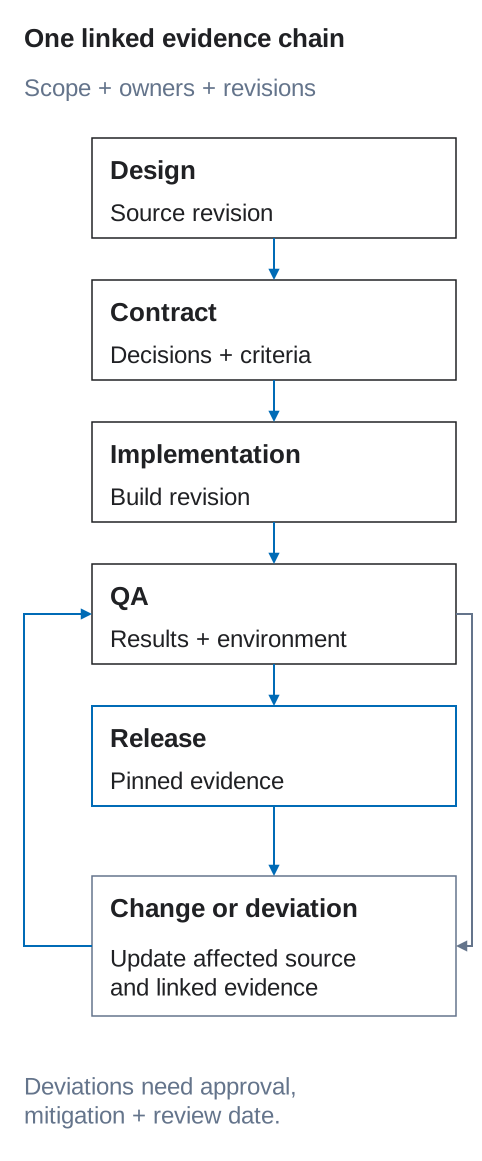
A deviation is a controlled branch that must return to verification; it is not a shortcut around the contract.
One chain of evidence
Section titled “One chain of evidence”Each important requirement receives a stable requirement id and links to its evidence:
REQ-CATALOG-017 design: Catalog / Default / 1200 → product-grid contract: bridge.data.displays → product-grid implementation: ProductGrid + catalog query adapter tests: catalog-grid-default, catalog-grid-empty, catalog-grid-keyboard deviations: noneDo not create five unrelated specifications. Figma shows authored visual/structural evidence; structured DFC Bridge metadata records intent Figma cannot express; code realizes it; tests verify outcomes; deviations record known differences. Stable identities connect the evidence.
Roles and accountability
Section titled “Roles and accountability”| Role | Accountable for |
|---|---|
| Product/design owner | Product meaning, complete states, design evidence, content, responsive intent. |
| Contract owner | Consistency, identity mapping, structured metadata, acceptance criteria, change log. |
| Implementation owner | Semantic behavior, target-platform decisions, code and implementation evidence. |
| QA/accessibility owner | Coverage, environments, expected results, findings, regression evidence. |
| Deviation approver | User/business impact decision, mitigation, owner, expiry and follow-up. |
One person may fill several roles. The author must not be the only person able to interpret the design, and a known divergence cannot be silently approved by the implementer who introduced it.
Lifecycle record
Section titled “Lifecycle record”A transfer unit—page, flow, section, or component—has one lifecycle record:
Non-standalone module fragment. This excerpt shows only
bridge.lifecycle(pluscontractVersionfor context) and intentionally omits other required envelope fields. Insert it into the requiredbridgeenvelope from the transfer contract before exchange or full-contract validation.
{ "bridge": { "contractVersion": "0.2.0", "lifecycle": { "transferId": "catalog-default", "contractRevision": "7", "sourceRevision": "figma-version-2026-08-13T10:20Z", "targetRevision": "build-1842", "status": "qa", "owners": { "design": "catalog-design", "contract": "design-systems", "implementation": "storefront", "qa": "quality" }, "requirements": ["REQ-CATALOG-017", "REQ-CATALOG-021"], "evidence": { "design": ["page=catalog;view=default;bp=1200"], "tests": ["catalog-grid-default", "catalog-grid-keyboard"] }, "deviations": [] } }}Names are illustrative. A repository, issue tracker, design plugin, or build system may store the record, but it must be versioned, linkable, and delivered with the transfer unit.
Selected section inside a legacy host
Section titled “Selected section inside a legacy host”A section-scope lifecycle has two distinct source/integration gates:
- selected-section source gate — pins the
[section=<stable-id>]root(s), selected-subtree boundary, selected contexts, source revision, local findings, and deferred dependencies; - file/host integration gate — verifies internal routes/anchors and action/component/data targets requiring lookup outside selected roots, parent placement and clipping/stacking, route/page relationships, required product contexts, page semantics, runtime behavior, and implementation accessibility. Complete valid
http:,https:,mailto:, andtel:hrefs are already authored-resolved at the source gate; incomplete or malformed external values block that gate rather than defer.
The source gate is invalid when a selected section lies below a different opaque [asset] ancestor; that scope is Blocked before traversal. An exact [section=id] [asset] selected root remains a valid opaque whole-visual source with internal layout coverage N/A.
Check selected section can produce Ready, Partial, or Blocked evidence for the first gate. Store that label with its scope and coverage matrix; do not replace bridge.lifecycle.status with it and do not use it as evidence that the second gate passed. A Ready single-context section source is valid when only that context was requested. A deferred file-resolved reference or selected section root that is itself an INSTANCE makes the source result Partial until the linked gate supplies evidence. Ordinary descendant instances are trusted atomic boundaries and do not lower Ready.
The legacy host is a declared boundary, not an accepted DFC Bridge deviation and not a hidden migration requirement. The lifecycle record must say hostCompliance: legacy-out-of-scope, link every external dependency to an owner/review point, and prevent “section source ready” from becoming “page/product ready” in downstream status or release notes.
Stage 1: design
Section titled “Stage 1: design”The design owner prepares representative, production-relevant evidence:
- root page/view/breakpoint identities and real routes when known;
- same logical tree across responsive states, plus every declared transformation;
- stable element identity and component/template provenance;
- realistic content and runtime-data fixtures;
- complete reactions, targets, forms, async and failure states;
- motion states and fallbacks;
- accessibility intent and alternatives;
- essential media/experience plus asset art direction and representative low-capability conditions;
- known target constraints and candidate exceptions.
Design gate: a reviewer who is not the author can identify structure, variants, content/data meaning, actions, targets, responsive behavior, accessibility expectations, and unresolved decisions without a private explanation.
Output: versioned design reference, fixture/scenario list, open-decision list, and initial requirement ids.
Stage 2: contract
Section titled “Stage 2: contract”The contract owner combines evidence instead of duplicating it:
- extract technical truth from Figma or the source tool;
- resolve stable identity as role, template, design instance, runtime data, and target identity;
- attach structured data, responsive, reaction, motion, accessibility, and lifecycle contracts;
- define acceptance criteria and target capabilities;
- turn every unknown or unsupported capability into an owned open question with scope, blocking status, review point, and safe fallback;
- define expected data volume, virtualization/pagination threshold, asset delivery intent, and implementation-owned performance budgets;
- validate references, targets, schemas, state reachability, parity, and exceptions;
- freeze a contract revision for implementation.
Contract gate: every required decision is either explicit, inherited from a pinned component/system contract, or recorded as an owned open decision that blocks the affected scope. No implementation-critical meaning exists only in chat or a meeting.
Output: pinned source revision, structured contract, trace matrix, target capability statement, validation report, and approved implementation scope.
Stage 3: implementation
Section titled “Stage 3: implementation”The implementation owner maps the contract to the target platform. The adapter or developer must:
- preserve semantic identity and relationships rather than copy coordinates blindly;
- use native target behavior and the design system where they satisfy the contract;
- implement exact declared frames/scenes first, then fluid/container behavior;
- map runtime records through stable data keys rather than Figma fixture order;
- implement all reachable states, reactions, history/focus effects, and fallbacks;
- record target-specific decisions that are not visually observable;
- implement and measure asset, data-volume, loading, low-bandwidth/offline/data-saver/low-power, and capability-fallback budgets;
- flag impossible or harmful requirements before substituting another behavior.
Implementation gate: the feature builds, deterministic contract checks pass, every requirement points to implementation evidence, and no known divergence is hidden.
Output: implementation revision, mapping/decision notes, automated tests, and candidate deviation records.
Stage 4: QA
Section titled “Stage 4: QA”QA verifies observable outcomes against the frozen contract, not against memory or a single screenshot.
Required coverage includes:
- exact declared breakpoints and the ranges between them;
- container-driven changes and each declared structural transformation;
- typical and stress data, every required data state, and localization;
- happy, invalid, pending, empty, partial, failure, cancellation, retry, and history paths;
- reverse/re-entry/reduced-motion behavior for motion;
- keyboard, focus, zoom/reflow, screen-reader, contrast, target size, and media requirements;
- supported browsers, devices, target runtimes, and fallback conditions;
- asset dimensions/quality/art direction/loading priority and data-volume/virtualization thresholds under the declared capability profiles;
- low bandwidth, offline, data saver, low power, missing capability, and budget evidence as applicable;
- component/system inheritance and visual regression at meaningful states.
Classify results as pass, fail, not-applicable, blocked, or accepted-deviation; include evidence and environment. “Looks close” is not a result.
QA gate: every acceptance criterion has a result; blockers are resolved; accepted deviations are approved and visible; regression coverage exists for high-risk behavior.
Output: linked QA report, evidence, defect records, approved deviations, and release recommendation.
Stage 5: release and operation
Section titled “Stage 5: release and operation”At release, pin together:
- design/source revision;
- contract and rules/schema versions;
- implementation/build revision;
- test environment and evidence revision;
- active deviations and expiry dates.
After release, runtime evidence may reveal content lengths, data volumes, device conditions, assistive-technology issues, or performance limitations absent from fixtures. Feed these back into the source design, component contract, examples, and tests. Do not patch production forever while the canonical contract remains wrong.
Open-question protocol
Section titled “Open-question protocol”DFC Bridge promises no untracked unknowns, not omniscience. A decision may remain unknown, unsupported, or TBD only in bridge.openQuestions[] with a stable id, exact scope, accountable owner, blocking status, due date or named review gate, safe fallback, and status/decision link.
At each lifecycle gate:
- review every question whose scope enters the next stage;
- block the scope when its fallback would be unsafe, inaccessible, misleading, destructive, or impossible to test;
- carry a non-blocking fallback into implementation and QA acceptance criteria;
- close the record only with a linked decision and updated affected evidence;
- escalate overdue questions instead of silently assuming an answer.
A question that remains only in conversation, chat, an unlinked task, or a person’s memory is a blind spot and fails readiness.
Change control and contract drift
Section titled “Change control and contract drift”A change begins at the owner of the truth it alters:
| Change | Update first | Then reassess |
|---|---|---|
| Copy, visual hierarchy, or product flow | Design evidence | Contract, implementation, tests |
| Data schema/source/format | Data contract | Fixtures, displays, states, tests |
| Interaction/state behavior | Reaction contract | Designs, focus/history, implementation, tests |
| Component API or target limitation | Implementation/system contract | Design mapping, deviations, regressions |
| Accessibility finding | Requirement and affected evidence | Design, contract, implementation, all variants |
Run impact analysis by stable identity and requirement id. A source revision change after contract freeze either creates a new contract revision or is explicitly proven non-semantic. Silent screenshot replacement is contract drift.
Deviation protocol
Section titled “Deviation protocol”A deviation is an intentional, reviewed mismatch between the accepted contract and the implementation or supported target. It is not an undocumented workaround.
Every deviation is stored under bridge.lifecycle.deviations:
Non-standalone module fragment. This excerpt isolates one
bridge.lifecycle.deviationsrecord and intentionally omits the remaining lifecycle and required envelope fields. Insert it into a complete lifecycle record inside the required contract envelope.
{ "bridge": { "lifecycle": { "deviations": [{ "id": "DEV-CATALOG-004", "requirement": "REQ-CATALOG-021", "scope": ["catalog", "catalog-360"], "difference": "Comparison table uses horizontal scroll instead of the declared card transformation", "reason": "Card mapping loses grouped header relationships in target version", "impact": "Comparison remains available with preserved table semantics and no data loss, but narrow-screen users need additional horizontal navigation", "mitigation": "Sticky first column, overflow instructions, edge affordance", "evidence": ["qa-catalog-360-table-scroll"], "owner": "storefront", "approvedBy": "product-and-accessibility", "status": "accepted", "reviewDate": "2026-11-30", "resolution": "Reassess after target table component upgrade" }] } }}Required rules:
- identify the violated requirement and exact affected scope;
- explain user, accessibility, data, and maintenance impact;
- compare realistic alternatives;
- provide mitigation and verification evidence;
- name an accountable owner and approver;
- use an expiry/review date for temporary deviations;
- surface it in handoff, QA, and release records;
- close it only after the contract and implementation converge and are retested.
A deviation that prevents WCAG 2.2 AA cannot be relabeled as conforming. Security, privacy, legal, and data-integrity constraints override visual fidelity and must be escalated to the relevant owner.
Definition of ready and done
Section titled “Definition of ready and done”Ready for implementation
Section titled “Ready for implementation”- Scope and revisions are pinned.
- Stable identities and target mapping are unambiguous.
- Structured contracts cover data, transformations, reactions, motion, and accessibility where applicable.
- Acceptance criteria and test scenarios exist.
- Required decisions have owners; blocking decisions are resolved.
- Every remaining unknown/unsupported item is a scoped, owned, reviewable open question with a safe tested fallback.
- Target capabilities, essential media/experience, data volume, degradation conditions, and implementation-owned budgets are declared.
- Candidate deviations have not been hidden as “implementation details.”
For a selected-section transfer, Ready from the source check satisfies only the source-evidence part of this list. The unit is Ready for implementation only when every blocking/deferred dependency required by the planned implementation has linked evidence or an owned safe fallback. Page/product/WCAG readiness remains a later scoped decision.
Done for release
Section titled “Done for release”- Implemented behavior traces to the accepted contract.
- Required exact, fluid, state, data, motion, and accessibility tests pass.
- Every failure in the release scope is fixed or approved as a visible deviation. An owned but unresolved blocker still prevents release of its affected scope.
- Active deviations have mitigation and review dates.
- Source, contract, code/build, and QA revisions are linked.
- Runtime feedback has a route back to the canonical source.
Worked change example
Section titled “Worked change example”A catalog table is designed at 1200 and 360 px. The contract declares same-tree reflow until the comparison-panel container is below 480 px, then a table-to-disclosure transformation mapping every column to a labeled field. Implementation discovers that the target disclosure component cannot preserve multi-row selection.
The team does not silently drop selection on mobile:
REQ-CATALOG-021states that selection survives presentation changes.- The developer records the capability gap before substituting behavior.
- Design evaluates keeping the semantic scrollable table versus adding selection to the disclosure component.
- Accessibility and product owners approve the scrollable-table mitigation temporarily.
- QA tests keyboard scrolling, headers, focus, selection, zoom, and Back/Forward at the affected range.
- The release links
DEV-CATALOG-004with an owner and expiry. - When the component gains selection, the team implements the original transformation, reruns the tests, and closes the deviation.
This is the DFC Bridge lifecycle: the gap is visible, owned, tested, and eventually removed.